


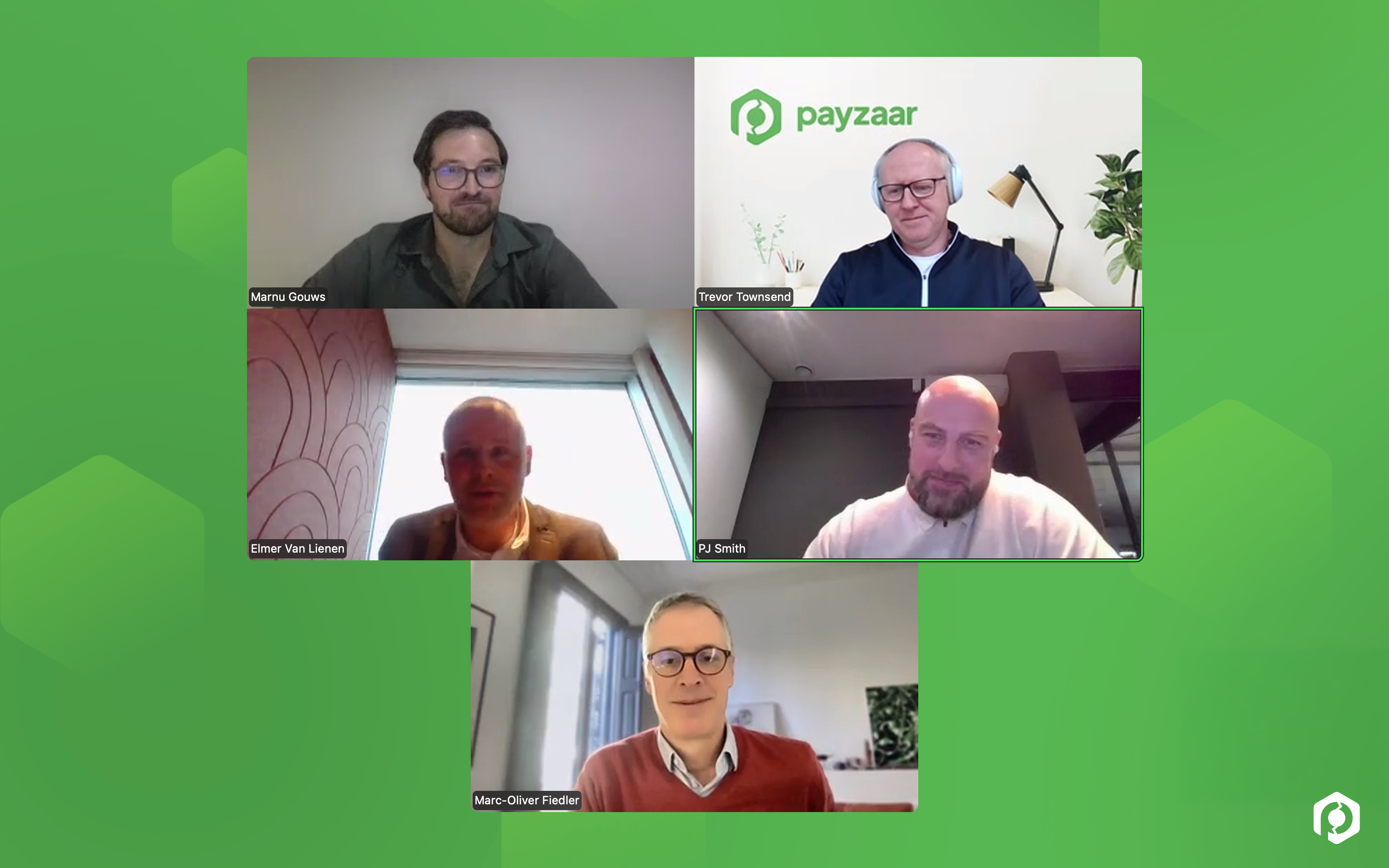
But how can technology serve as both the catalyst for change AND the key to navigating this industry transformation?
That was the central question of our recent live panel “The Role of Technology: Enabling Providers to Compete Better and Win More”. Payzaar founders Marc-Oliver Fiedler and Trevor Townsend were joined by Elmer van Lienen, Marnu Gouws, and Peter-John Smith from global accountancy firm Newtone for a wide-ranging discussion exploring the future of Provider services, their Payzaar-powered Ignys platform, and the role AI will play in the years ahead.
Here are the key insights from the conversation:
The Iceberg Effect: Below the Surface in the Current Provider Landscape
Payroll has always been complex, but today’s global environment has vastly expanded and intensified the list of responsibilities expected from multi-country payroll teams.
Peter-John Smith, Newtone’s Global Senior Payroll Specialist, explained that the days of simply processing paychecks are long gone.
“People see payroll as the tip of the iceberg but they don’t see the huge operational mass below the surface”.
Behind every payslip sits a vast infrastructure of data validation, compliance checks, in-depth reporting, and coordination across jurisdictions. Organizations expect to stay compliant and maintain operational efficiency, yet many still rely on fragmented systems and manual processes. Peter-John warned this creates major visibility gaps for leadership teams trying to ensure global visibility and security.
“Clients lose the ability to compare regions and spot any risks.”
This complexity, however, also represents a major opportunity for Payroll Providers willing to modernize their service offering. As Newtone’s Global Senior Payroll Specialist Marnu Gouws explained, organizations are no longer looking for a simple payroll engine.
“Clients no longer want just one payroll system to do the processing. They want workflows and reporting visibility across different countries.”
This sentiment was echoed by Elmer van Lienen, Tax Partner at Newtone, as he highlighted technology as the clear solution to keep up with payroll’s growing list of responsibilities.
“It has become more and more important to use technology to be able to meet the requirements and controls that companies want.”
Time to Value: Meeting Rising Client Expectations
Alongside growing complexity, client expectations are also shifting dramatically. Organizations now expect faster implementations, speedier onboarding of new countries, and near-instant access to actionable insights from payroll data.
According to Elmer, clients are becoming less preoccupied by cost and increasingly focused on value.
“Do you want to pay as little as possible? Or do you want to have more quality?”
Technology is central to delivering this higher level of service. Clients now expect systems that allow them to access meaningful data quickly and scale operations across markets without long setup timelines.
Peter-John highlighted how these expectations are already shaping Provider relationships, particularly in the global payroll space where traditional implementations can take months before delivering tangible value.
“Clients want to onboard faster, implement countries faster, and access meaningful reporting immediately.”
Trevor Townsend described this trend as the rise of “time to value” as a critical metric for Providers. To keep pace, tech-enabled platforms that allow Providers to adapt alongside their clients’ expansion plans and operational changes have shifted from a “nice-to-have" feature to a business necessity.
“You need tools and platforms that allow you to hit the time to value and adapt as your customer moves across markets and makes changes within those markets as well.”
Technology as a Differentiator: From Processor to Advisor
As the payroll function becomes more dynamic and market competition grows, technology is enabling Providers to stay agile and demonstrate clear business value to clients.
Modern payroll solutions like Newtone’s Ignys platform enable faster communication, more reliable reporting, and stronger compliance oversight across multiple stakeholders. They also facilitate deeper collaboration between payroll teams, HR departments, auditors, and tax specialists.
Elmer couldn’t stress the importance of tech-powered collaboration enough:
“The only way to be a good partner in the organization is by using state-of-the-art technology.”
A Provider’s tech stack will not only redefine the value they bring to existing partnerships, it will also serve as a clear market differentiator to win new business. According to Trevor, Providers must be able to clearly outline their value proposition for clients and their tech toolkit will be crucial in gaining a competitive edge.
“Technology will play a major role in competition and it won’t be a level playing field. It will be a big factor in how providers protect their margin and demonstrate ROI.”
Trevor also acknowledged that the immediate benefits of technology such as reducing risk, automating mundane processes, and delivering higher quality service should be seen as “the basic expectation” of these powerful tools. The real long-term value, he noted, will be the ways in which automation frees payroll professionals up to contribute to their organizations in meaningful strategic capacities.
“By using technology to drive higher degrees of automation, payroll providers can move from the perception of processor to advisor.”
However, there will be some internal hurdles to overcome before payroll can truly embrace this new advisory role...
Solving the Data Challenge: From Fragmentation to Insights
One of the biggest barriers to payroll innovation remains fragmented data.
Many organizations operate across multiple systems, providers, and jurisdictions, leaving payroll professionals to deal with flawed or inconsistent data inputs that slow down reporting and increase the risk of errors.
Trevor described the problem bluntly:
“Fragmented data is the root of all evil. But it’s also a reality.”
Technology therefore plays a crucial role in allowing teams to do more with the resources they have. Modern platforms can deliver significant value by consolidating data into a unified, reliable source of information.
Trevor described the vision as a “single pane of glass” for payroll operations, where data is validated, structured, and accessible across the organization. This saves payroll teams from hours of manual data entry and correction, and creates more opportunities to shift their focus onto strategic planning.
“It allows people to focus on the advisory piece and not be chasing down inaccuracies arising out of payroll data.”
For service providers like Newtone, this kind of visibility unlocks immediate practical benefits such as deeper reporting to improved operational efficiency that Marnu noted has “transformed the day-to-day of payroll”.
“Technology allows us to not react to problems anymore but proactively look at what the issues might be before they occur.”
In fact, proactive data monitoring and validation can eliminate the majority of processing issues before payroll runs even begin. Peter-John thanked payroll platforms like Payzaar for helping to finally relieve payroll of these long-standing “data-related headaches”.
“We’re all very excited about the expansion, efficiency, and reporting that Payzaar offers and where the technology is going.”
AI in Payroll: Leveling the Playing Field
The final segment of the panel was spent discussing the most anticipated topic on the agenda: Artificial Intelligence.
Although many applications are still in development, AI is already impacting payroll with the ability to automate quality checks, identify inconsistent data, and flag missing payroll inputs long before they cause issues. Marnu reflected on the current reality of AI use for Providers:
“It’s very exciting technology but right now AI plays more of a role in the process leading up to the payroll than the actual payroll itself.”
Looking ahead, AI holds the potential to drastically transform Providers’ ability to analyze and share insights with clients from their own vast regulatory and financial data pools. As Trevor eagerly explained:
“Organizations like Newtone sit on a treasure trove of information about payroll legislation and regulations all over the world that can now be unlocked with AI”.
Trevor also predicted this new analytic horsepower fueled by AI could help Providers to overcome existing growth issues by allowing them to expand their service capacity without increasing operational overhead.
“Providers have a problem with scaling. AI technology will help you scale while improving engagement across your organization.”
Peter-John highlighted this advantage as a unique opportunity for specialized Providers to bridge the gap between themselves and their larger competitors.
“AI is levelling the playing field for local providers. It gives smaller teams the structure and the controls you would expect from much bigger organizations.”
But Peter-John was also quick to emphasize that AI should be viewed as an enhancement to human expertise, not a replacement for what makes local Providers essential within the payroll ecosystem.
“Your payroll doesn’t have to be a burden. We need to make sure that we use technology but keep the human element in it.”
Elmer shared a similarly measured take, seeking to assuage concerns that increased automation will lead to redundancy for payroll professionals.
“AI will be important but it will not be the solution to everything. It won’t replace the human in the loop that is critical to validate if things are going right.”
It will be through an eagerness to learn and refine the technology that Elmer sees AI’s full potential to support payroll teams being unlocked: “Adapt to it, see the opportunities, and then make it better.”
Final Thoughts: Embracing the Next Era of Payroll
If the breadth and diversity of this live panel discussion made one thing very clear, it’s that payroll is truly entering a new chapter.
Technology is no longer just a supporting tool; it is becoming the foundation that enables Payroll Providers to deliver faster, more insightful, and increasingly strategic services to customers.
As Marc-Oliver summarized during the closing Q&A, Providers who are willing to embrace innovation while maintaining the human touch behind payroll that stand to benefit most from this industry transformation.
“Don’t shift away from service and expertise. Use technology to take care of the groundwork so you can elevate your service with targeted improvements. You don’t need to boil the ocean if you have some very specific pain points.”
Trevor also reiterated technology’s potential to enable payroll professionals to “do more with the same amount of people at higher values” and signed off with a question for local Providers:
“How can technology deliver more service and unlock the people I have in my organization to engage on a human-to-human level?”
And perhaps the theme of the live panel was best encapsulated by Elmer’s powerful final message to payroll professionals, which was enthusiastically supported by his fellow Newtone compatriots Marnu and Peter-John:
“Don’t be afraid of changes. Look at the opportunities of technology, not the threats.”
For Providers navigating an increasingly complex and competitive global landscape, this open-minded approach may prove to be the ultimate tool for surviving and thriving in the new technological era of payroll.
--
Thank you for reading! You can listen to Plug And Pay recap episode on Spotify & Apple Podcasts now or watch the full live panel below. And stay tuned for announcements about future virtual and in-person events on the Payzaar LinkedIn page.


